- Role
- Co-founder and tech lead. Two-person team.
- Duration
- October 2024 to May 2026
- Deployed at
- Yale Health, orthopedics department
- Stack
- Rust services, Python AI pipeline, React/TypeScript, PostgreSQL with row-level security, Docker/Helm, observability
- Outcome
- Live pilot, then final-stage enterprise procurement. Wound down May 2026.
The problem
American hospitals still run on fax as the primary intake channel for referrals and prior authorization. The orthopedics department at Yale Health receives thousands of faxed documents a month, and every one of them moved through a chain of manual steps before anything happened to the patient.
| Step | What it actually involved |
|---|---|
| Intake | Two full-time staff read each incoming fax, identify the patient, identify the treating physician, and forward to the right administrator |
| Preparation | Administrator opens the scan in Adobe and hand-places text boxes and checkboxes onto the page |
| Data entry | Administrator looks the patient up in Epic and gathers information scattered across the chart, writing a narrative if the form needs one |
| Signature | Sent through DocuSign to the physician, who signs or returns it for correction |
| Return | Back to the administrator, back to the routers, back out by fax to the sender |
Average time from arrival to return: one to two weeks.
The work was invisible in the way that matters commercially. It never appeared as a line item, because it was distributed across people who were nominally doing something else.
What we built
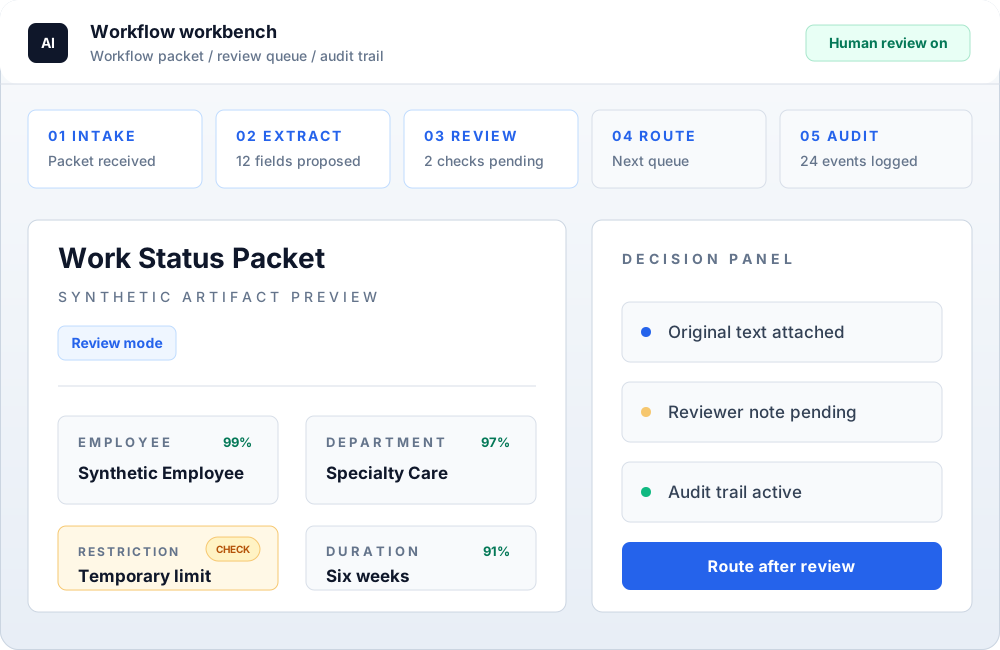
One intake pipeline replacing the chain. Each stage below was a surface a real user worked in, not a background job.
- Automated ingestion and classification of inbound faxes by document type
- Structured extraction into the specific fields a prior-authorization reviewer needs, with confidence carried through rather than discarded
- Deterministic routing by document type and department, so a document reached the right person without a human deciding
- A review surface where source wording stayed visible beside every extracted field
- Integrated signature, replacing the separate per-envelope e-signature step
- Batch signing for physicians, grouping similar documents with a summary instead of a stack of near-identical PDFs
- Audit events at every state transition, so the workflow could answer who saw what, and when, months later
The decision that mattered most
Low-confidence extractions routed to a human instead of being filled in. Nothing was ever silently populated, everything stayed editable, and the places the system was unsure were the places it asked.
In a clinical setting a value that is wrong but looks certain is more dangerous than no value at all, because it gets trusted.
This cost throughput and it was still correct. Automating 80% of the work reliably beats automating 100% of it unreliably, because the second one gets switched off after the first bad outcome and there is no second pilot.
Designing the pilot around a blocker we could not remove
We could not get access to Yale's Epic instance without SOC 2 and HIPAA compliance already in place, which a two-person company did not have. So we had a working system and no way to prove it worked.
Rather than wait, we built the pilot around the constraint. Templates for the highest-frequency documents, common patterns pre-filled, patient data still entered by hand, everything editable. Administrators approved each document and sent it to the physician through our platform. It capped the ceiling on what the pilot could demonstrate, and it let us demonstrate anything at all.
Results
| Measure | Result |
|---|---|
| Pilot length | Two months, live, in one department |
| Documents fully automated | 2,000 |
| Administrative hours recovered | 300 |
| Implied rate | About nine minutes of staff time per document |
| Modeled annual opportunity | $15M+ across the health system. A model, not a measurement. |
Nine minutes per document is the number I would defend in any room, because we measured it. The $15M figure extrapolates that rate across department count and document volume and adds clinician review time, displaced routing headcount, and per-envelope signature fees. It turns on how many departments look like orthopedics, and I would walk through the sensitivity before asking anyone to believe it.
Outcome
We cleared security review and clinical workflow review, and reached final-stage procurement with the health system's senior digital and clinical information executives. The orthopedics team came with us and validated the results.
We lost on vendor maturity. They needed a vendor with institutional history who would still exist in five years to support the integration, and two students could not satisfy that. It was not a product decision. We wound down in May 2026 after my cofounder left for a master's program abroad.
The extraction method and source code are covered by an NDA with Yale. Everything above is the product story: what was built, what it did, and what happened. I do not discuss the mechanism.